

Introduction
Tri-21B를 4bit으로 양자화한 모델
We introduce Tri-21B, our flagship large language model that redefines the efficiency frontier in LLM training. By achieving state-of-the-art performance with only 2.3T training tokens, we demonstrate that exceptional capabilities don't require excessive computational resources.
Key Highlights
- Unprecedented Training Efficiency: Trained on just 2.3T tokens—significantly less than comparable models—while achieving 70.3% average accuracy across MMLU/KMMLU/Global MMLU benchmarks
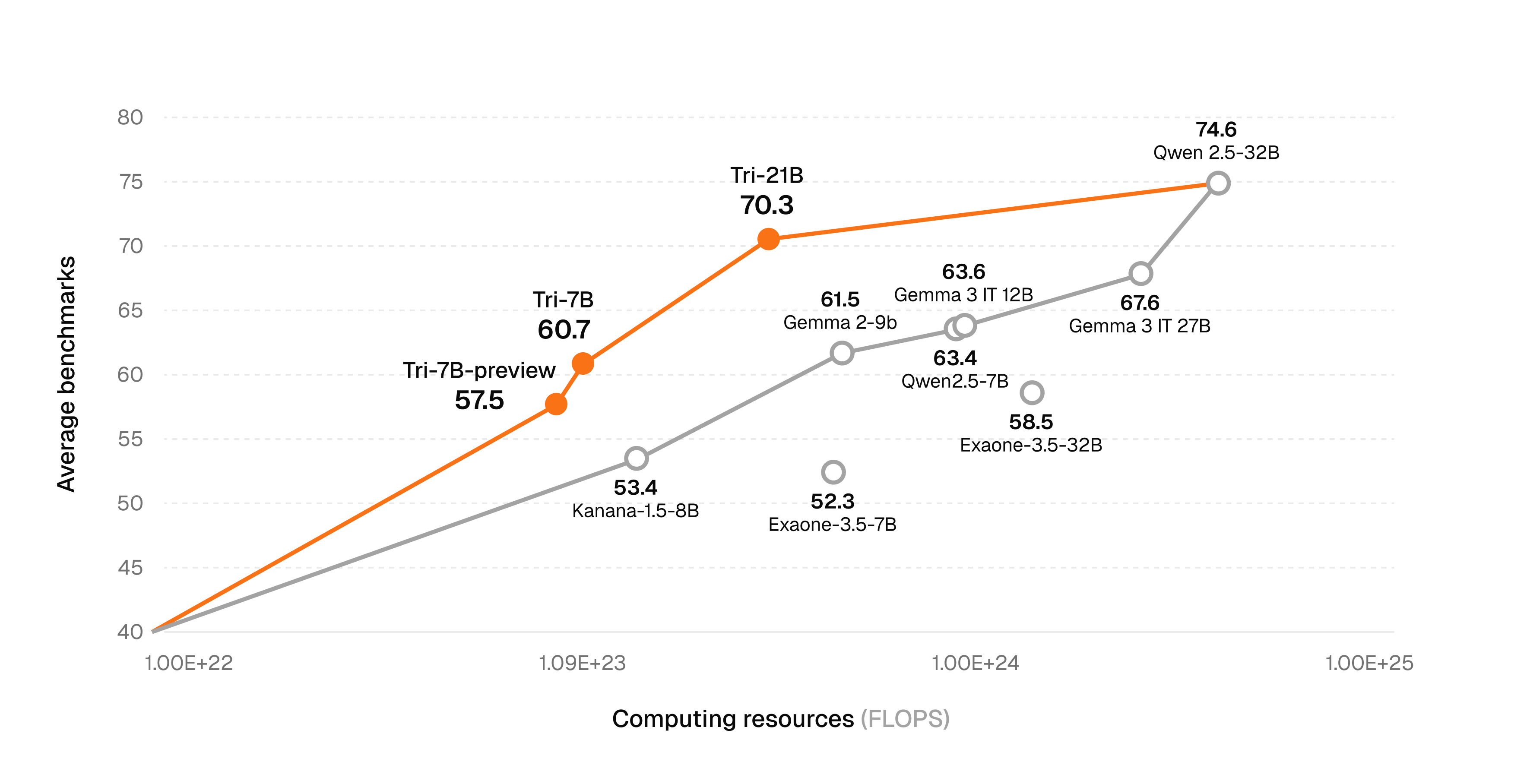
- Pushing the Pareto Frontier: With only 2.95E+23 FLOPs, Tri-21B outperforms models requiring 2-10x more compute, setting a new standard for efficient scaling
- Enhanced Reasoning: Modified training dataset mixture specifically optimized for reasoning capabilities
- Advanced Post-Training: Significantly improved RL training pipeline focusing on mathematical reasoning and everyday usage
- Multi-lingual: Specially optimized for Korean, English, and Japanese.
Our Tri-21B represents a paradigm shift in efficient model development. When comparing performance to training FLOPs, our model dramatically pushes the Pareto frontier—achieving performance comparable to or exceeding models like Qwen2.5-32B (74.6% at 3.46E+24 FLOPs) and Gemma 3 IT 27B (67.6% at 2.27E+24 FLOPs) while using approximately 8-12x fewer computational resources.
Model Specifications
Tri-21B
- Type: Causal Language Model
- Training Stage: Pre-training & Post-training
- Architecture: Transformer Decoder with RoPE, SwiGLU, RMSNorm, and GQA
- Number of Parameters: 20.73B
- Number of Layers: 32
- Number of Attention Heads: 32 (Query) / 8 (Key, Value)
- Context Length: 8,192
- Number of Tokens Seen: 2.3T
- Vocab Size: 124,416
Training Efficiency Analysis
Our approach to training efficiency sets new benchmarks in the field. The following comparison demonstrates how Tri-21B achieves superior performance per FLOP compared to other state-of-the-art models of similar scale:
| Model | FLOPs | Avg. Accuracy¹ | Efficiency Ratio² |
|---|---|---|---|
| Tri-21B | 2.95E+23 | 70.3% | 1.00x (baseline) |
| Gemma2-9b | 4.42E+23 | 61.5% | 0.48x |
| Qwen2.5-7B | 8.22E+23 | 63.4% | 0.29x |
| Exaone-3.5-32B | 1.25E+24 | 58.5% | 0.19x |
| Gemma 3 IT 27B | 2.27E+24 | 67.6% | 0.11x |
| Qwen2.5-32B | 3.46E+24 | 74.6% | 0.10x |
| Qwen3-32B | 5.77E+24 | 73.5% | 0.06x |
¹ Average of MMLU / KMMLU / Global MMLU (ja)
² Performance per FLOP relative to Tri-21B
This efficiency breakthrough enables organizations to deploy state-of-the-art language models without the traditional computational barriers, democratizing access to advanced AI capabilities.
Quickstart
Here is a code snippet with apply_chat_template that demonstrates how to load the tokenizer and model and generate text.
Tri-21B Usage
import torch
from transformers import AutoModelForCausalLM, AutoTokenizer

model_name = "trillionlabs/Tri-21B"

model = AutoModelForCausalLM.from_pretrained(
    model_name,
    torch_dtype=torch.bfloat16,
    device_map="auto"
)
tokenizer = AutoTokenizer.from_pretrained(model_name)

prompt = "Explain the concept of quantum computing in simple terms."
messages = [
    {"role": "user", "content": prompt}
]
text = tokenizer.apply_chat_template(
    messages,
    tokenize=False,
    add_generation_prompt=True
)
model_inputs = tokenizer([text], return_tensors="pt").to(model.device)

generated_ids = model.generate(
    **model_inputs,
    max_new_tokens=512
)
generated_ids = [
    output_ids[len(input_ids):] for input_ids, output_ids in zip(model_inputs.input_ids, generated_ids)
]

response = tokenizer.batch_decode(generated_ids, skip_special_tokens=True)[0]
print(response)
vLLM, SGLang Deployment
Tri-21B is also available with vLLM and SGLang!
# vLLM
vllm serve trillionlabs/Tri-21B --dtype bfloat16 --max-model-len 8192

# vLLM with custom options
vllm serve trillionlabs/Tri-21B \
    --dtype bfloat16 \
    --max-model-len 8192 \
    --gpu-memory-utilization 0.95 \
    --port 8000
# SGLang
python3 -m sglang.launch_server --model-path trillionlabs/Tri-21B --dtype bfloat16

# SGLang with custom options
python3 -m sglang.launch_server \
    --model-path trillionlabs/Tri-21B \
    --dtype bfloat16 \
    --context-length 8192 \
    --port 30000 \
    --host 0.0.0.0
Evaluation
We evaluated Tri-21B across a comprehensive suite of benchmarks assessing general reasoning, knowledge recall, coding abilities, mathematical reasoning, and instruction-following capabilities. We compare our model against state-of-the-art models of similar scale: Gemmma-3-IT-27B and Qwen3-32B to demonstrate its competitive performance.
Full evaluation settings
# Benchmark Evaluation Settings| Benchmark | Language | Evaluation Setting | Metric |
|---|---|---|---|
| General Reasoning and Factuality | |||
| • HellaSwag | English | 0-shot | accuracy |
| • ARC:C | English | 0-shot | accuracy |
| • HAERAE | Korean | 3-shot | accuracy |
| • CLIcK | Korean | 0-shot | accuracy |
| • KoBEST | Korean | 5-shot | accuracy |
| Knowledge and Reasoning | |||
| • KMMLU | Korean | 5-shot (0-shot, CoT) | accuracy (exact-match) |
| • MMLU | English | 5-shot (0-shot, CoT) | accuracy (exact-match) |
| • MMLU-Pro | English | 0-shot, CoT | exact-match |
| • Global-MMLU-Lite-ja | Japaneses | 5-shot | accuracy |
| Coding | |||
| • HumanEval | English | 0-shot | pass@1 |
| • MBPPPlus | English | 0-shot | pass@1 |
| Mathematical Reasoning | |||
| • GSM8k | English | 0-shot, CoT | exact-match |
| • MATH | English | 0-shot, CoT | exact-match |
| • GPQA | English | 4-shot | accuracy |
| • GPQA Diamond | English | 0-shot, CoT | accuracy |
| • HRM8k | Korean | 0-shot, CoT | exact-match |
| Instruction Following and Chat | |||
| • IFEval | English | 0-shot | strict-average |
| • koIFEval | Korean | 0-shot | strict-average |
| • MT-Bench | English | LLM-as-a-judge (gpt-4o) | LLM score |
| • KO-MT-Bench | Korean | LLM-as-a-judge (gpt-4o) | LLM score |
| • systemIFEval | English | 0-shot | strict-average |
- *Note that koIFEval, systemIFEval, and KoRuler are our in-house evaluation benchmarks adapted for Korean to better assess model capabilities in Korean language tasks.
- **Note that MT-Bench, KO-MT-Bench, and LogicKor use a 10-point scale.
Benchmark Results
Models compared:
- Tri-21B: Our flagship 21B parameter model
- Qwen3-32B: Qwen's 32B parameter model
- Gemma3-IT-27B: Google's Gemma 3 instruction-tuned 27B model
General Reasoning and Factuality
| Benchmark | Tri-21B | Qwen3-32B | Gemma3-IT-27B |
|---|---|---|---|
| HAERAE | 86.16 | 71.67 | 78.09 |
| KoBEST | 85.92 | 83.39 | 87.66 |
| CLIcK | 72.32 | 66.89 | 67.54 |
| KMMLU | 61.89 (69.90) | 61.73 (67.55) | 55.03 (60.61) |
| MMLU | 77.62 (85.02) | 81.86 (84.46) | 77.42 (84.09) |
| MMLU-Pro | 64.74 | 70.53 | 64.26 |
| Global-MMLU-Lite-ja | 70.25 | 77.00 | 72.00 |
Coding
| Benchmark | Tri-21B | Qwen3-32B | Gemma3-IT-27B |
|---|---|---|---|
| HumanEval | 75.61 | 74.39 | 87.80 |
| MBPPPlus | 73.02 | 74.40 | 84.92 |
Mathematical Reasoning
| Benchmark | Tri-21B | Qwen3-32B | Gemma3-IT-27B |
|---|---|---|---|
| GSM8k | 87.95 | 86.66 | 90.52 |
| MATH | 77.60 | 81.40 | 85.00 |
| GPQA | 39.73 | 41.07 | 37.95 |
| GPQA-Diamond | 44.95 | 54.04 | 44.44 |
| HRM8k | 56.70 | 66.24 | 63.90 |
Instruction Following and Chat
| Benchmark | Tri-21B | Qwen3-32B | Gemma3-IT-27B |
|---|---|---|---|
| IFEval | 80.75 | 86.08 | 80.78 |
| koIFEval | 66.51 | 62.93 | 69.24 |
| MT-Bench | 8.21 | 8.52 | 8.53 |
| KO-MT-Bench | 7.79 | 8.47 | 8.46 |
| systemIFEval | 77.40 | 77.92 | 77.94 |
Base Model Evaluation
The following table shows the performance of Tri-21B base model (before instruction tuning) on key benchmarks:
| Benchmark | Tri-21B Base |
|---|---|
| MMLU | 76.99 |
| KMMLU | 62.37 |
| KoBEST | 85.07 |
| BBH | 77.19 |
| GSM8K | 70.36 |
| MBPPPlus | 75.40 |
Limitations
- Language Support: The models are optimized for English, Korean, and Japanese. Usage with other languages may result in degraded performance.
- Knowledge Cutoff: The model's information is limited to data available up to Febuary, 2025.
License
This model repository is licensed under the Trillion License.
Contact
For inquiries, please contact: info@trillionlabs.co
- Downloads last month
- 31