
Hub documentation
Audit Logs
Audit Logs
This feature is part of the Team & Enterprise plans.
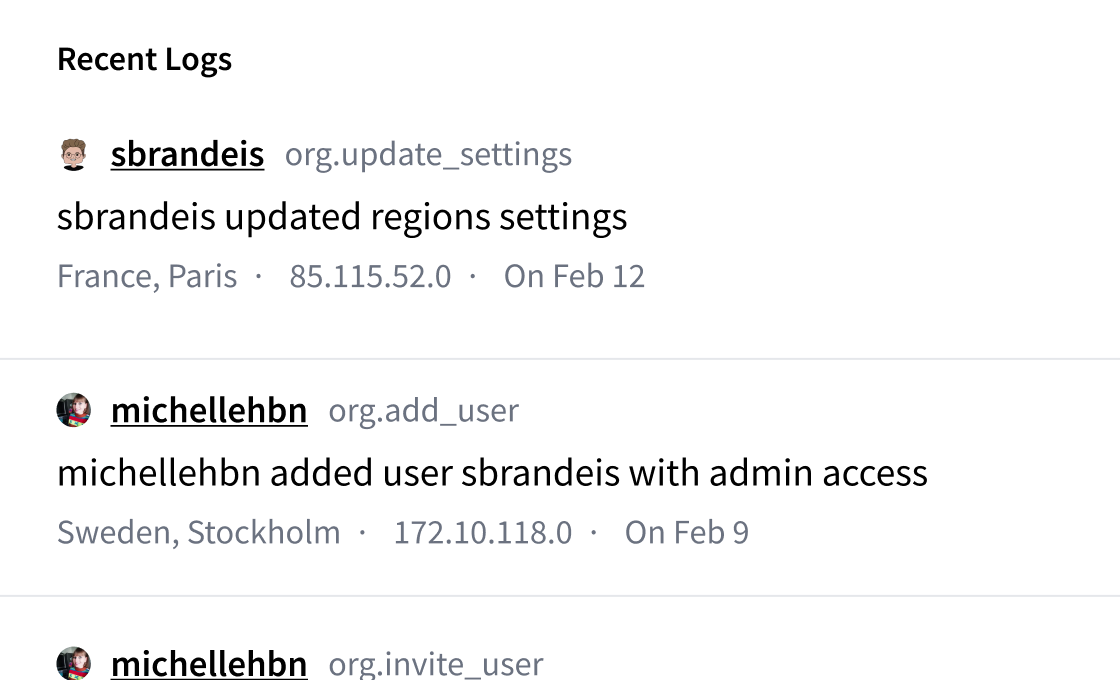
Audit Logs enable organization admins to easily review actions taken by members, including organization membership, repository settings and billing changes.
Accessing Audit Logs
Audit Logs are accessible through your organization settings. Each log entry includes:
- Who performed the action
- What type of action was taken
- A description of the change
- Location and anonymized IP address
- Date and time of the action
You can also download the complete audit log as a JSON file for further analysis.
Export via API
Programmatic export is available at:
GET https://huggingface.co/api/organizations/{org}/audit-log/exportAuthenticate with a user access token or service-account token that has the Export the audit log permission (org.auditLog.write) for the organization. The response is a JSON array of log entries, identical to the file downloaded from the settings page. Like the manual export, the API call is recorded as org.audit_log.export.
The endpoint is also documented in the OpenAPI reference.
What Events Are Tracked?
Each action has an event name in scope.action format (e.g. repo.create, collection.delete). This is the type field in each log entry and in the exported JSON—use it when searching or filtering logs.
Organization Management & Security
The Settings changes events below are only available for actions taken after June 16th, 2026. Events before that date use a unique
org.update_settingsevent type. Any integration that filters or parses the eventtypefield for orgs created before June 16th, 2026, should handle both.
- Core organization changes — Creation, deletion, restoration, and renaming.
- Events:
org.create,org.delete,org.restore,org.rename
- Events:
- Settings changes — Updates to organization settings are recorded as granular
org.settings.*events, so you can pinpoint exactly which setting changed.- General settings — Profile, storage regions, resource groups, and publisher gating.
- Events:
org.settings.profile,org.settings.regions,org.settings.resource_groups,org.settings.publisher_gating - Inference providers — Provider configuration, API key add/remove, and usage settings.
- Events:
org.settings.inference_providers,org.settings.inference_providers.keys.add,org.settings.inference_providers.keys.remove,org.settings.inference_providers.usage - SSO — SSO configuration updates, and enabling or disabling SSO.
- Events:
org.settings.sso,org.settings.sso.enable,org.settings.sso.disable - Security — Default repository visibility, and enabling or disabling 2FA enforcement, automatic join, and member privacy.
- Events:
org.settings.security.repo_visibility,org.settings.security.2fa.enable,org.settings.security.2fa.disable,org.settings.security.auto_join.enable,org.settings.security.auto_join.disable,org.settings.security.members_privacy.enable,org.settings.security.members_privacy.disable - Network — Network configuration updates, and enabling or disabling IP access restriction and authentication enforcement.
- Events:
org.settings.network,org.settings.network.ip_restriction.enable,org.settings.network.ip_restriction.disable,org.settings.network.auth_enforcement.enable,org.settings.network.auth_enforcement.disable
- Security management
- Organization API token rotation.
- Event:
org.rotate_token - Token approval system — Enabling or disabling the policy, authorization requests, approvals, denials, and revocations.
- Events:
org.token_approval.enabled,org.token_approval.disabled,org.token_approval.authorization_request,org.token_approval.authorization_request.authorized,org.token_approval.authorization_request.revoked,org.token_approval.authorization_request.denied - SSO — Logins and joins via SSO.
- Events:
org.sso_login,org.sso_join
- Join settings — Domain-based access and automatic join configuration.
- Event:
org.update_join_settings
- Event:
Membership and Access Control
- Member lifecycle — Adding and removing members, role changes, and members leaving the organization.
- Events:
org.add_user,org.remove_user,org.change_role,org.leave
- Events:
- Invitations — Sending invites, invitation links by email, and users accepting invites.
- Events:
org.invite_user,org.invite.accept,org.invite.email
- Events:
- Automatic joins — Joins via verified email domain or “request access”.
- Events:
org.join.from_domain,org.join.automatic
- Events:
Content and Resource Management
- Repository administration — Creation, deletion, moving, disabling/re-enabling, duplication settings, DOI removal, resource group assignment, and general repo settings (visibility, gating, discussions, etc.). Also LFS file deletion.
- Events:
repo.create,repo.delete,repo.move,repo.disable,repo.removeDisable,repo.duplication,repo.delete_doi,repo.update_resource_group,repo.update_settings,repo.delete_lfs_file
- Events:
- Collections — Creation and deletion of collections.
- Events:
collection.create,collection.delete
- Events:
- Repository security — Secrets and variables (individual and bulk add/update/remove).
- Events (secrets):
repo.add_secret,repo.update_secret,repo.remove_secret,repo.add_secrets,repo.remove_secrets - Events (variables):
repo.add_variable,repo.update_variable,repo.remove_variable,repo.add_variables,repo.remove_variables
- Events (secrets):
- Spaces configuration — Storage tier changes, hardware (flavor) updates, and sleep time adjustments.
- Events:
spaces.add_storage,spaces.remove_storage,spaces.update_hardware,spaces.update_sleep_time
- Events:
Resource Groups
- Resource group administration — Creation, deletion, and settings changes.
- Events:
resource_group.create,resource_group.delete,resource_group.settings
- Events:
- Resource group members — Adding and removing users, and role changes.
- Events:
resource_group.add_users,resource_group.remove_users,resource_group.change_role
- Events:
Jobs and Scheduled Jobs
- Jobs — Job creation (e.g. on a Space) and cancellation.
- Events:
jobs.create,jobs.cancel
- Events:
- Scheduled jobs — Creating, deleting, resuming, suspending, and triggering runs.
- Events:
scheduled_job.create,scheduled_job.delete,scheduled_job.resume,scheduled_job.suspend,scheduled_job.run
- Events:
Billing and Cloud Integration
- Payment and customers — Payment method updates, attachment, and removal; customer account creation.
- Events:
billing.update_payment_method,billing.create_customer,billing.remove_payment_method
- Events:
- Cloud marketplaces — AWS and GCP marketplace linking/unlinking and marketplace approval.
- Events:
billing.aws_add,billing.aws_remove,billing.gcp_add,billing.gcp_remove,billing.marketplace_approve
- Events:
- Subscriptions — Starting, renewing, cancelling, reactivating, and updating subscriptions (including plan and contract details).
- Events:
billing.start_subscription,billing.renew_subscription,billing.cancel_subscription,billing.un_cancel_subscription,billing.update_subscription,billing.update_subscription_plan,billing.update_subscription_contract_details
- Events:
Event reference
The list above covers every event type shown in the audit log UI and export. Event names follow the scope.action pattern; scopes include org, repo, collection, spaces, resource_group, jobs, scheduled_job, and billing. The export action itself is recorded as org.audit_log.export but that event is not included in the default audit log view.