
Transformers documentation
SAM
This model was published in HF papers on 2023-04-05 and contributed to Hugging Face Transformers on 2023-04-19.
SAM
Overview
SAM (Segment Anything Model) was proposed in Segment Anything by Alexander Kirillov, Eric Mintun, Nikhila Ravi, Hanzi Mao, Chloe Rolland, Laura Gustafson, Tete Xiao, Spencer Whitehead, Alex Berg, Wan-Yen Lo, Piotr Dollar, Ross Girshick.
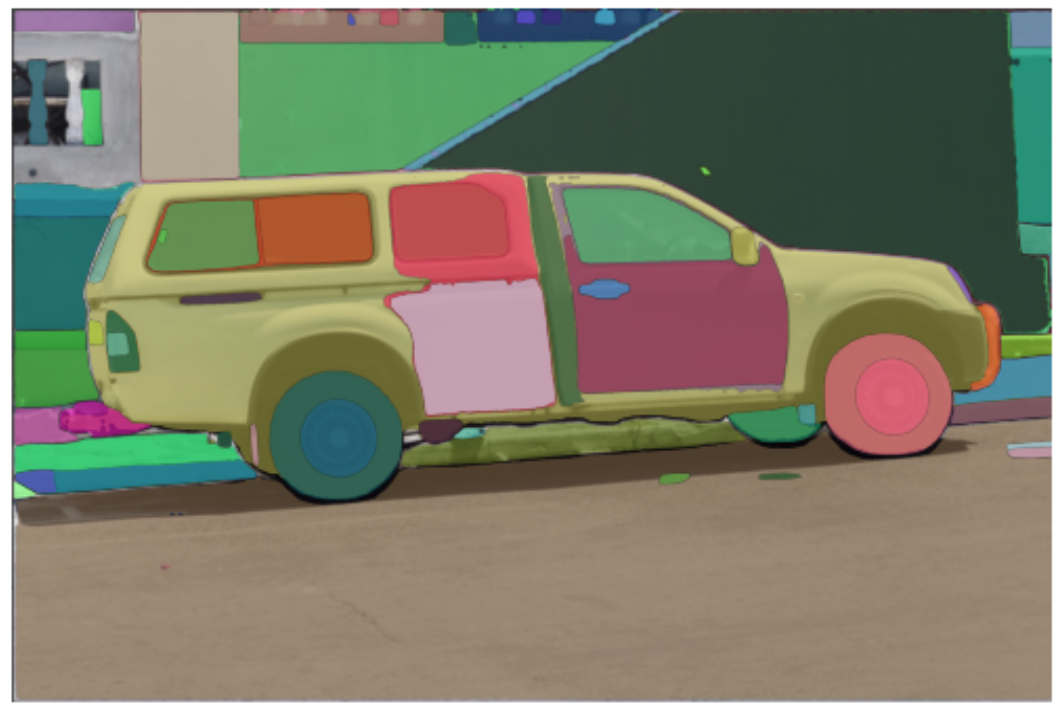
The model can be used to predict segmentation masks of any object of interest given an input image.
The abstract from the paper is the following:
We introduce the Segment Anything (SA) project: a new task, model, and dataset for image segmentation. Using our efficient model in a data collection loop, we built the largest segmentation dataset to date (by far), with over 1 billion masks on 11M licensed and privacy respecting images. The model is designed and trained to be promptable, so it can transfer zero-shot to new image distributions and tasks. We evaluate its capabilities on numerous tasks and find that its zero-shot performance is impressive — often competitive with or even superior to prior fully supervised results. We are releasing the Segment Anything Model (SAM) and corresponding dataset (SA-1B) of 1B masks and 11M images at https://segment-anything.com to foster research into foundation models for computer vision.
Tips:
- The model predicts binary masks that states the presence or not of the object of interest given an image.
- The model predicts much better results if input 2D points and/or input bounding boxes are provided
- You can prompt multiple points for the same image, and predict a single mask.
- Fine-tuning the model is not supported yet
- According to the paper, textual input should be also supported. However, at this time of writing this seems not to be supported according to the official repository.
This model was contributed by ybelkada and ArthurZ. The original code can be found here.
Below is an example on how to run mask generation given an image and a 2D point:
import requests
import torch
from PIL import Image

from transformers import SamModel, SamProcessor


model = SamModel.from_pretrained("facebook/sam-vit-huge", device_map="auto")
processor = SamProcessor.from_pretrained("facebook/sam-vit-huge")

img_url = "https://huggingface.co/ybelkada/segment-anything/resolve/main/assets/car.png"
raw_image = Image.open(requests.get(img_url, stream=True).raw).convert("RGB")
input_points = [[[450, 600]]]  # 2D location of a window in the image

inputs = processor(raw_image, input_points=input_points, return_tensors="pt").to(model.device)
with torch.no_grad():
    outputs = model(**inputs)

masks = processor.image_processor.post_process_masks(
    outputs.pred_masks.cpu(), inputs["original_sizes"].cpu(), inputs["reshaped_input_sizes"].cpu()
)
scores = outputs.iou_scores
You can also process your own masks alongside the input images in the processor to be passed to the model.
import requests
import torch
from PIL import Image

from transformers import SamModel, SamProcessor


model = SamModel.from_pretrained("facebook/sam-vit-huge", device_map="auto")
processor = SamProcessor.from_pretrained("facebook/sam-vit-huge")

img_url = "https://huggingface.co/ybelkada/segment-anything/resolve/main/assets/car.png"
raw_image = Image.open(requests.get(img_url, stream=True).raw).convert("RGB")
mask_url = "https://huggingface.co/ybelkada/segment-anything/resolve/main/assets/car.png"
segmentation_map = Image.open(requests.get(mask_url, stream=True).raw).convert("1")
input_points = [[[450, 600]]]  # 2D location of a window in the image

inputs = processor(raw_image, input_points=input_points, segmentation_maps=segmentation_map, return_tensors="pt").to(model.device)
with torch.no_grad():
    outputs = model(**inputs)

masks = processor.image_processor.post_process_masks(
    outputs.pred_masks.cpu(), inputs["original_sizes"].cpu(), inputs["reshaped_input_sizes"].cpu()
)
scores = outputs.iou_scores
Resources
A list of official Hugging Face and community (indicated by 🌎) resources to help you get started with SAM.
- Demo notebook for using the model.
- Demo notebook for using the automatic mask generation pipeline.
- Demo notebook for inference with MedSAM, a fine-tuned version of SAM on the medical domain. 🌎
- Demo notebook for fine-tuning the model on custom data. 🌎
SlimSAM
SlimSAM, a pruned version of SAM, was proposed in 0.1% Data Makes Segment Anything Slim by Zigeng Chen et al. SlimSAM reduces the size of the SAM models considerably while maintaining the same performance.
Checkpoints can be found on the hub, and they can be used as a drop-in replacement of SAM.
Grounded SAM
One can combine Grounding DINO with SAM for text-based mask generation as introduced in Grounded SAM: Assembling Open-World Models for Diverse Visual Tasks. You can refer to this demo notebook 🌍 for details.
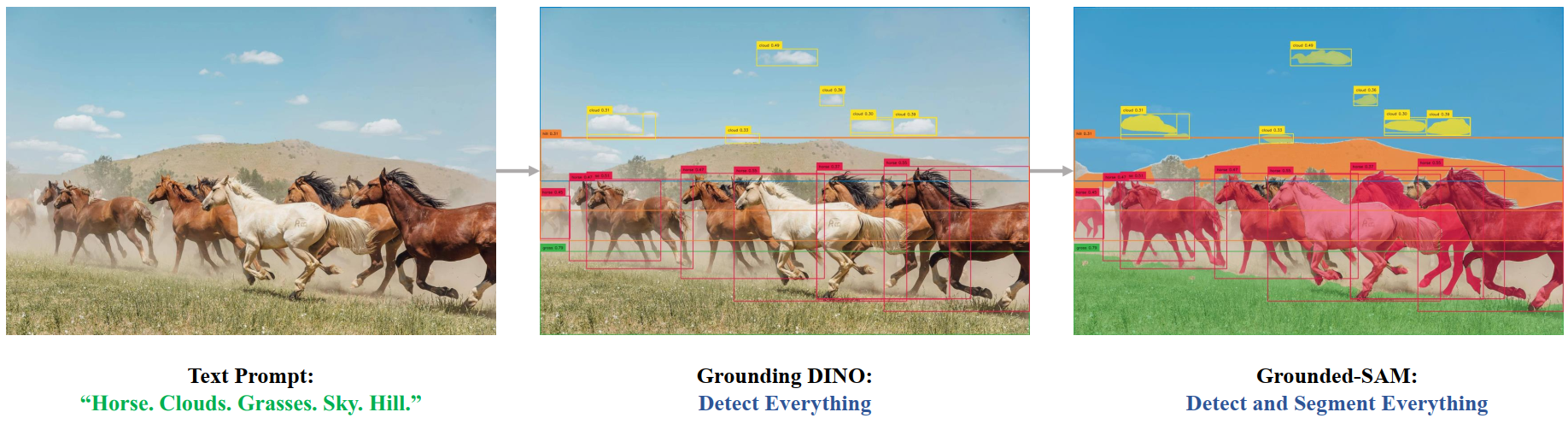 Grounded SAM overview. Taken from the original repository.
 SamConfig
class transformers.SamConfig
< source >( transformers_version: str | None = None architectures: list[str] | None = None output_hidden_states: bool | None = False return_dict: bool | None = True dtype: typing.Union[str, ForwardRef('torch.dtype'), NoneType] = None chunk_size_feed_forward: int = 0 is_encoder_decoder: bool = False id2label: dict[int, str] | dict[str, str] | None = None label2id: dict[str, int] | dict[str, str] | None = None problem_type: typing.Optional[typing.Literal['regression', 'single_label_classification', 'multi_label_classification']] = None vision_config: dict | transformers.configuration_utils.PreTrainedConfig | None = None prompt_encoder_config: dict | transformers.configuration_utils.PreTrainedConfig | None = None mask_decoder_config: dict | transformers.configuration_utils.PreTrainedConfig | None = None initializer_range: float = 0.02 tie_word_embeddings: bool = True )
Parameters
- vision_config (
Union[dict, ~configuration_utils.PreTrainedConfig], optional) — The config object or dictionary of the vision backbone. - prompt_encoder_config (Union[
dict,SamPromptEncoderConfig], optional) — Dictionary of configuration options used to initialize SamPromptEncoderConfig. - mask_decoder_config (Union[
dict,SamMaskDecoderConfig], optional) — Dictionary of configuration options used to initialize SamMaskDecoderConfig. - initializer_range (
float, optional, defaults to0.02) — The standard deviation of the truncated_normal_initializer for initializing all weight matrices. - tie_word_embeddings (
bool, optional, defaults toTrue) — Whether to tie weight embeddings according to model’stied_weights_keysmapping.
This is the configuration class to store the configuration of a SamModel. It is used to instantiate a Sam model according to the specified arguments, defining the model architecture. Instantiating a configuration with the defaults will yield a similar configuration to that of the facebook/sam-vit-huge
Configuration objects inherit from PreTrainedConfig and can be used to control the model outputs. Read the documentation from PreTrainedConfig for more information.
Example:
>>> from transformers import (
...     SamVisionConfig,
...     SamPromptEncoderConfig,
...     SamMaskDecoderConfig,
...     SamModel,
... )

>>> # Initializing a SamConfig with `"facebook/sam-vit-huge"` style configuration
>>> configuration = SamConfig()

>>> # Initializing a SamModel (with random weights) from the `"facebook/sam-vit-huge"` style configuration
>>> model = SamModel(configuration)

>>> # Accessing the model configuration
>>> configuration = model.config

>>> # We can also initialize a SamConfig from a SamVisionConfig, SamPromptEncoderConfig, and SamMaskDecoderConfig

>>> # Initializing SAM vision, SAM Q-Former and language model configurations
>>> vision_config = SamVisionConfig()
>>> prompt_encoder_config = SamPromptEncoderConfig()
>>> mask_decoder_config = SamMaskDecoderConfig()

>>> config = SamConfig(vision_config, prompt_encoder_config, mask_decoder_config)
SamVisionConfig
class transformers.SamVisionConfig
< source >( transformers_version: str | None = None architectures: list[str] | None = None output_hidden_states: bool | None = False return_dict: bool | None = True dtype: typing.Union[str, ForwardRef('torch.dtype'), NoneType] = None chunk_size_feed_forward: int = 0 is_encoder_decoder: bool = False id2label: dict[int, str] | dict[str, str] | None = None label2id: dict[str, int] | dict[str, str] | None = None problem_type: typing.Optional[typing.Literal['regression', 'single_label_classification', 'multi_label_classification']] = None hidden_size: int = 768 output_channels: int = 256 num_hidden_layers: int = 12 num_attention_heads: int = 12 num_channels: int = 3 image_size: int | list[int] | tuple[int, int] = 1024 patch_size: int | list[int] | tuple[int, int] = 16 hidden_act: str = 'gelu' layer_norm_eps: float = 1e-06 attention_dropout: float | int = 0.0 initializer_range: float = 1e-10 qkv_bias: bool = True mlp_ratio: float = 4.0 use_abs_pos: bool = True use_rel_pos: bool = True window_size: int = 14 global_attn_indexes: list[int] | tuple[int, ...] = (2, 5, 8, 11) num_pos_feats: int = 128 mlp_dim: int | None = None )
Parameters
- hidden_size (
int, optional, defaults to768) — Dimension of the hidden representations. - output_channels (
int, optional, defaults to 256) — Dimensionality of the output channels in the Patch Encoder. - num_hidden_layers (
int, optional, defaults to12) — Number of hidden layers in the Transformer decoder. - num_attention_heads (
int, optional, defaults to12) — Number of attention heads for each attention layer in the Transformer decoder. - num_channels (
int, optional, defaults to3) — The number of input channels. - image_size (
Union[int, list[int], tuple[int, int]], optional, defaults to1024) — The size (resolution) of each image. - patch_size (
Union[int, list[int], tuple[int, int]], optional, defaults to16) — The size (resolution) of each patch. - hidden_act (
str, optional, defaults togelu) — The non-linear activation function (function or string) in the decoder. For example,"gelu","relu","silu", etc. - layer_norm_eps (
float, optional, defaults to1e-06) — The epsilon used by the layer normalization layers. - attention_dropout (
Union[float, int], optional, defaults to0.0) — The dropout ratio for the attention probabilities. - initializer_range (
float, optional, defaults to1e-10) — The standard deviation of the truncated_normal_initializer for initializing all weight matrices. - qkv_bias (
bool, optional, defaults toTrue) — Whether to add a bias to the queries, keys and values. - mlp_ratio (
float, optional, defaults to4.0) — Ratio of the MLP hidden dim to the embedding dim. - use_abs_pos (
bool, optional, defaults toTrue) — Whether to use absolute position embeddings. - use_rel_pos (
bool, optional, defaults toTrue) — Whether to use relative position embedding. - window_size (
int, optional, defaults to 14) — Window size for relative position. - global_attn_indexes (
list[int], optional, defaults to[2, 5, 8, 11]) — The indexes of the global attention layers. - num_pos_feats (
int, optional, defaults to 128) — The dimensionality of the position embedding. - mlp_dim (
int, optional) — The dimensionality of the MLP layer in the Transformer encoder. IfNone, defaults tomlp_ratio * hidden_size.
This is the configuration class to store the configuration of a SamModel. It is used to instantiate a Sam model according to the specified arguments, defining the model architecture. Instantiating a configuration with the defaults will yield a similar configuration to that of the facebook/sam-vit-huge
Configuration objects inherit from PreTrainedConfig and can be used to control the model outputs. Read the documentation from PreTrainedConfig for more information.
Example:
>>> from transformers import (
...     SamVisionConfig,
...     SamVisionModel,
... )

>>> # Initializing a SamVisionConfig with `"facebook/sam-vit-huge"` style configuration
>>> configuration = SamVisionConfig()

>>> # Initializing a SamVisionModel (with random weights) from the `"facebook/sam-vit-huge"` style configuration
>>> model = SamVisionModel(configuration)

>>> # Accessing the model configuration
>>> configuration = model.config
SamMaskDecoderConfig
class transformers.SamMaskDecoderConfig
< source >( transformers_version: str | None = None architectures: list[str] | None = None output_hidden_states: bool | None = False return_dict: bool | None = True dtype: typing.Union[str, ForwardRef('torch.dtype'), NoneType] = None chunk_size_feed_forward: int = 0 is_encoder_decoder: bool = False id2label: dict[int, str] | dict[str, str] | None = None label2id: dict[str, int] | dict[str, str] | None = None problem_type: typing.Optional[typing.Literal['regression', 'single_label_classification', 'multi_label_classification']] = None hidden_size: int = 256 hidden_act: str = 'relu' mlp_dim: int = 2048 num_hidden_layers: int = 2 num_attention_heads: int = 8 attention_downsample_rate: int = 2 num_multimask_outputs: int = 3 iou_head_depth: int = 3 iou_head_hidden_dim: int = 256 layer_norm_eps: float = 1e-06 )
Parameters
- hidden_size (
int, optional, defaults to256) — Dimension of the hidden representations. - hidden_act (
str, optional, defaults torelu) — The non-linear activation function (function or string) in the decoder. For example,"gelu","relu","silu", etc. - mlp_dim (
int, optional, defaults to 2048) — Dimensionality of the “intermediate” (i.e., feed-forward) layer in the Transformer encoder. - num_hidden_layers (
int, optional, defaults to2) — Number of hidden layers in the Transformer decoder. - num_attention_heads (
int, optional, defaults to8) — Number of attention heads for each attention layer in the Transformer decoder. - attention_downsample_rate (
int, optional, defaults to 2) — The downsampling rate of the attention layer. - num_multimask_outputs (
int, optional, defaults to 3) — The number of outputs from theSamMaskDecodermodule. In the Segment Anything paper, this is set to 3. - iou_head_depth (
int, optional, defaults to 3) — The number of layers in the IoU head module. - iou_head_hidden_dim (
int, optional, defaults to 256) — The dimensionality of the hidden states in the IoU head module. - layer_norm_eps (
float, optional, defaults to1e-06) — The epsilon used by the layer normalization layers.
This is the configuration class to store the configuration of a SamModel. It is used to instantiate a Sam model according to the specified arguments, defining the model architecture. Instantiating a configuration with the defaults will yield a similar configuration to that of the facebook/sam-vit-huge
Configuration objects inherit from PreTrainedConfig and can be used to control the model outputs. Read the documentation from PreTrainedConfig for more information.
SamPromptEncoderConfig
class transformers.SamPromptEncoderConfig
< source >( transformers_version: str | None = None architectures: list[str] | None = None output_hidden_states: bool | None = False return_dict: bool | None = True dtype: typing.Union[str, ForwardRef('torch.dtype'), NoneType] = None chunk_size_feed_forward: int = 0 is_encoder_decoder: bool = False id2label: dict[int, str] | dict[str, str] | None = None label2id: dict[str, int] | dict[str, str] | None = None problem_type: typing.Optional[typing.Literal['regression', 'single_label_classification', 'multi_label_classification']] = None hidden_size: int = 256 image_size: int | list[int] | tuple[int, int] = 1024 patch_size: int | list[int] | tuple[int, int] = 16 mask_input_channels: int = 16 num_point_embeddings: int = 4 hidden_act: str = 'gelu' layer_norm_eps: float = 1e-06 )
Parameters
- hidden_size (
int, optional, defaults to256) — Dimension of the hidden representations. - image_size (
Union[int, list[int], tuple[int, int]], optional, defaults to1024) — The size (resolution) of each image. - patch_size (
Union[int, list[int], tuple[int, int]], optional, defaults to16) — The size (resolution) of each patch. - mask_input_channels (
int, optional, defaults to 16) — The number of channels to be fed to theMaskDecodermodule. - num_point_embeddings (
int, optional, defaults to 4) — The number of point embeddings to be used. - hidden_act (
str, optional, defaults togelu) — The non-linear activation function (function or string) in the decoder. For example,"gelu","relu","silu", etc. - layer_norm_eps (
float, optional, defaults to1e-06) — The epsilon used by the layer normalization layers.
This is the configuration class to store the configuration of a SamModel. It is used to instantiate a Sam model according to the specified arguments, defining the model architecture. Instantiating a configuration with the defaults will yield a similar configuration to that of the facebook/sam-vit-huge
Configuration objects inherit from PreTrainedConfig and can be used to control the model outputs. Read the documentation from PreTrainedConfig for more information.
SamProcessor
class transformers.SamProcessor
< source >( image_processor )
Constructs a SamProcessor which wraps a image processor into a single processor.
SamProcessor offers all the functionalities of SamImageProcessor. See the ~SamImageProcessor for more information.
__call__
< source >( images: typing.Union[ForwardRef('PIL.Image.Image'), numpy.ndarray, ForwardRef('torch.Tensor'), list['PIL.Image.Image'], list[numpy.ndarray], list['torch.Tensor'], NoneType] = None text: str | list[str] | list[list[str]] | None = None **kwargs ) → ~tokenization_utils_base.BatchEncoding
Parameters
- images (
Union[PIL.Image.Image, numpy.ndarray, torch.Tensor, list[PIL.Image.Image], list[numpy.ndarray], list[torch.Tensor]], optional) — Image to preprocess. Expects a single or batch of images with pixel values ranging from 0 to 255. If passing in images with pixel values between 0 and 1, setdo_rescale=False. - text (
Union[str, list[str], list[list[str]]], optional) — The sequence or batch of sequences to be encoded. Each sequence can be a string or a list of strings (pretokenized string). If you pass a pretokenized input, setis_split_into_words=Trueto avoid ambiguity with batched inputs. - return_tensors (
stror TensorType, optional) — If set, will return tensors of a particular framework. Acceptable values are:'pt': Return PyTorchtorch.Tensorobjects.'np': Return NumPynp.ndarrayobjects.
Returns
~tokenization_utils_base.BatchEncoding
- data (
dict, optional) — Dictionary of lists/arrays/tensors returned by the__call__/encode_plus/batch_encode_plusmethods (‘input_ids’, ‘attention_mask’, etc.). - encoding (
tokenizers.EncodingorSequence[tokenizers.Encoding], optional) — If the tokenizer is a fast tokenizer which outputs additional information like mapping from word/character space to token space thetokenizers.Encodinginstance or list of instance (for batches) hold this information. - tensor_type (
Union[None, str, TensorType], optional) — You can give a tensor_type here to convert the lists of integers in PyTorch/Numpy Tensors at initialization. - prepend_batch_axis (
bool, optional, defaults toFalse) — Whether or not to add a batch axis when converting to tensors (seetensor_typeabove). Note that this parameter has an effect if the parametertensor_typeis set, otherwise has no effect. - n_sequences (
int, optional) — You can give a tensor_type here to convert the lists of integers in PyTorch/Numpy Tensors at initialization.
SamImageProcessor
class transformers.SamImageProcessor
< source >( **kwargs: typing_extensions.Unpack[transformers.models.sam.image_processing_sam.SamImageProcessorKwargs] )
Parameters
- mask_size (
dict[str, *kwargs*, int], optional) — The size{"longest_edge": int}to resize the segmentation maps to. - mask_pad_size (
dict[str, *kwargs*, int], optional) — The size{"height": int, "width": int}to pad the segmentation maps to. Must be larger than any segmentation map size provided for preprocessing. - **kwargs (ImagesKwargs, optional) — Additional image preprocessing options. Model-specific kwargs are listed above; see the TypedDict class for the complete list of supported arguments.
Constructs a SamImageProcessor image processor.
preprocess
< source >( images: typing.Union[ForwardRef('PIL.Image.Image'), numpy.ndarray, ForwardRef('torch.Tensor'), list['PIL.Image.Image'], list[numpy.ndarray], list['torch.Tensor']] segmentation_maps: typing.Union[ForwardRef('PIL.Image.Image'), numpy.ndarray, ForwardRef('torch.Tensor'), list['PIL.Image.Image'], list[numpy.ndarray], list['torch.Tensor'], NoneType] = None **kwargs: typing_extensions.Unpack[transformers.models.sam.image_processing_sam.SamImageProcessorKwargs] ) → ~image_processing_base.BatchFeature
Parameters
- images (
Union[PIL.Image.Image, numpy.ndarray, torch.Tensor, list[PIL.Image.Image], list[numpy.ndarray], list[torch.Tensor]]) — Image to preprocess. Expects a single or batch of images with pixel values ranging from 0 to 255. If passing in images with pixel values between 0 and 1, setdo_rescale=False. - segmentation_maps (
ImageInput, optional) — The segmentation maps to preprocess. - mask_size (
dict[str, *kwargs*, int], optional) — The size{"longest_edge": int}to resize the segmentation maps to. - mask_pad_size (
dict[str, *kwargs*, int], optional) — The size{"height": int, "width": int}to pad the segmentation maps to. Must be larger than any segmentation map size provided for preprocessing. - return_tensors (
stror TensorType, optional) — Returns stacked tensors if set to'pt', otherwise returns a list of tensors. - **kwargs (ImagesKwargs, optional) — Additional image preprocessing options. Model-specific kwargs are listed above; see the TypedDict class for the complete list of supported arguments.
Returns
~image_processing_base.BatchFeature
- data (
dict) — Dictionary of lists/arrays/tensors returned by the call method (‘pixel_values’, etc.). - tensor_type (
Union[None, str, TensorType], optional) — You can give a tensor_type here to convert the lists of integers in PyTorch/Numpy Tensors at initialization.
SamImageProcessorPil
class transformers.SamImageProcessorPil
< source >( **kwargs: typing_extensions.Unpack[transformers.models.sam.image_processing_pil_sam.SamImageProcessorKwargs] )
Parameters
- mask_size (
dict[str, *kwargs*, int], optional) — The size{"longest_edge": int}to resize the segmentation maps to. - mask_pad_size (
dict[str, *kwargs*, int], optional) — The size{"height": int, "width": int}to pad the segmentation maps to. Must be larger than any segmentation map size provided for preprocessing. - **kwargs (ImagesKwargs, optional) — Additional image preprocessing options. Model-specific kwargs are listed above; see the TypedDict class for the complete list of supported arguments.
Constructs a SamImageProcessor image processor.
preprocess
< source >( images: typing.Union[ForwardRef('PIL.Image.Image'), numpy.ndarray, ForwardRef('torch.Tensor'), list['PIL.Image.Image'], list[numpy.ndarray], list['torch.Tensor']] segmentation_maps: typing.Union[ForwardRef('PIL.Image.Image'), numpy.ndarray, ForwardRef('torch.Tensor'), list['PIL.Image.Image'], list[numpy.ndarray], list['torch.Tensor'], NoneType] = None **kwargs: typing_extensions.Unpack[transformers.models.sam.image_processing_pil_sam.SamImageProcessorKwargs] ) → ~image_processing_base.BatchFeature
Parameters
- images (
Union[PIL.Image.Image, numpy.ndarray, torch.Tensor, list[PIL.Image.Image], list[numpy.ndarray], list[torch.Tensor]]) — Image to preprocess. Expects a single or batch of images with pixel values ranging from 0 to 255. If passing in images with pixel values between 0 and 1, setdo_rescale=False. - segmentation_maps (
ImageInput, optional) — The segmentation maps to preprocess. - mask_size (
dict[str, *kwargs*, int], optional) — The size{"longest_edge": int}to resize the segmentation maps to. - mask_pad_size (
dict[str, *kwargs*, int], optional) — The size{"height": int, "width": int}to pad the segmentation maps to. Must be larger than any segmentation map size provided for preprocessing. - return_tensors (
stror TensorType, optional) — Returns stacked tensors if set to'pt', otherwise returns a list of tensors. - **kwargs (ImagesKwargs, optional) — Additional image preprocessing options. Model-specific kwargs are listed above; see the TypedDict class for the complete list of supported arguments.
Returns
~image_processing_base.BatchFeature
- data (
dict) — Dictionary of lists/arrays/tensors returned by the call method (‘pixel_values’, etc.). - tensor_type (
Union[None, str, TensorType], optional) — You can give a tensor_type here to convert the lists of integers in PyTorch/Numpy Tensors at initialization.
SamVisionModel
class transformers.SamVisionModel
< source >( config: SamVisionConfig )
Parameters
- config (SamVisionConfig) — Model configuration class with all the parameters of the model. Initializing with a config file does not load the weights associated with the model, only the configuration. Check out the from_pretrained() method to load the model weights.
The vision model from Sam without any head or projection on top.
This model inherits from PreTrainedModel. Check the superclass documentation for the generic methods the library implements for all its model (such as downloading or saving, resizing the input embeddings, pruning heads etc.)
This model is also a PyTorch torch.nn.Module subclass. Use it as a regular PyTorch Module and refer to the PyTorch documentation for all matter related to general usage and behavior.
forward
< source >( pixel_values: torch.FloatTensor | None = None **kwargs: typing_extensions.Unpack[transformers.utils.generic.TransformersKwargs] ) → SamVisionEncoderOutput or tuple(torch.FloatTensor)
Parameters
- pixel_values (
torch.FloatTensorof shape(batch_size, num_channels, image_size, image_size), optional) — The tensors corresponding to the input images. Pixel values can be obtained using SamImageProcessor. SeeSamImageProcessor.__call__()for details (SamProcessor uses SamImageProcessor for processing images).
Returns
SamVisionEncoderOutput or tuple(torch.FloatTensor)
A SamVisionEncoderOutput or a tuple of
torch.FloatTensor (if return_dict=False is passed or when config.return_dict=False) comprising various
elements depending on the configuration (SamConfig) and inputs.
The SamVisionModel forward method, overrides the __call__ special method.
Although the recipe for forward pass needs to be defined within this function, one should call the
Moduleinstance afterwards instead of this since the former takes care of running the pre and post processing steps while the latter silently ignores them.
image_embeds (
torch.FloatTensorof shape(batch_size, output_dim)optional returned when model is initialized withwith_projection=True) — The image embeddings obtained by applying the projection layer to the pooler_output.last_hidden_state (
torch.FloatTensorof shape(batch_size, sequence_length, hidden_size), optional) — Sequence of hidden-states at the output of the last layer of the model.hidden_states (
tuple[torch.FloatTensor, ...], optional, returned whenoutput_hidden_states=Trueis passed or whenconfig.output_hidden_states=True) — Tuple oftorch.FloatTensor(one for the output of the embeddings, if the model has an embedding layer, + one for the output of each layer) of shape(batch_size, sequence_length, hidden_size).Hidden-states of the model at the output of each layer plus the optional initial embedding outputs.
attentions (
tuple[torch.FloatTensor, ...], optional, returned whenoutput_attentions=Trueis passed or whenconfig.output_attentions=True) — Tuple oftorch.FloatTensor(one for each layer) of shape(batch_size, num_heads, sequence_length, sequence_length).Attentions weights after the attention softmax, used to compute the weighted average in the self-attention heads.
SamModel
class transformers.SamModel
< source >( config: SamConfig )
Parameters
- config (SamConfig) — Model configuration class with all the parameters of the model. Initializing with a config file does not load the weights associated with the model, only the configuration. Check out the from_pretrained() method to load the model weights.
Segment Anything Model (SAM) for generating segmentation masks, given an input image and input points and labels, boxes, or masks.
This model inherits from PreTrainedModel. Check the superclass documentation for the generic methods the library implements for all its model (such as downloading or saving, resizing the input embeddings, pruning heads etc.)
This model is also a PyTorch torch.nn.Module subclass. Use it as a regular PyTorch Module and refer to the PyTorch documentation for all matter related to general usage and behavior.
forward
< source >( pixel_values: torch.FloatTensor | None = None input_points: torch.FloatTensor | None = None input_labels: torch.LongTensor | None = None input_boxes: torch.FloatTensor | None = None input_masks: torch.LongTensor | None = None image_embeddings: torch.FloatTensor | None = None multimask_output: bool = True attention_similarity: torch.FloatTensor | None = None target_embedding: torch.FloatTensor | None = None **kwargs: typing_extensions.Unpack[transformers.utils.generic.TransformersKwargs] ) → SamImageSegmentationOutput or tuple(torch.FloatTensor)
Parameters
- pixel_values (
torch.FloatTensorof shape(batch_size, num_channels, image_size, image_size), optional) — The tensors corresponding to the input images. Pixel values can be obtained using SamImageProcessor. SeeSamImageProcessor.__call__()for details (SamProcessor uses SamImageProcessor for processing images). - input_points (
torch.FloatTensorof shape(batch_size, num_points, 2)) — Input 2D spatial points, this is used by the prompt encoder to encode the prompt. Generally yields to much better results. The points can be obtained by passing a list of list of list to the processor that will create correspondingtorchtensors of dimension 4. The first dimension is the image batch size, the second dimension is the point batch size (i.e. how many segmentation masks do we want the model to predict per input point), the third dimension is the number of points per segmentation mask (it is possible to pass multiple points for a single mask), and the last dimension is the x (vertical) and y (horizontal) coordinates of the point. If a different number of points is passed either for each image, or for each mask, the processor will create “PAD” points that will correspond to the (0, 0) coordinate, and the computation of the embedding will be skipped for these points using the labels. - input_labels (
torch.LongTensorof shape(batch_size, point_batch_size, num_points)) — Input labels for the points, this is used by the prompt encoder to encode the prompt. According to the official implementation, there are 3 types of labels1: the point is a point that contains the object of interest0: the point is a point that does not contain the object of interest-1: the point corresponds to the background
We added the label:
-10: the point is a padding point, thus should be ignored by the prompt encoder
The padding labels should be automatically done by the processor.
- input_boxes (
torch.FloatTensorof shape(batch_size, num_boxes, 4)) — Input boxes for the points, this is used by the prompt encoder to encode the prompt. Generally yields to much better generated masks. The boxes can be obtained by passing a list of list of list to the processor, that will generate atorchtensor, with each dimension corresponding respectively to the image batch size, the number of boxes per image and the coordinates of the top left and bottom right point of the box. In the order (x1,y1,x2,y2):x1: the x coordinate of the top left point of the input boxy1: the y coordinate of the top left point of the input boxx2: the x coordinate of the bottom right point of the input boxy2: the y coordinate of the bottom right point of the input box
- input_masks (
torch.FloatTensorof shape(batch_size, image_size, image_size)) — SAM model also accepts segmentation masks as input. The mask will be embedded by the prompt encoder to generate a corresponding embedding, that will be fed later on to the mask decoder. These masks needs to be manually fed by the user, and they need to be of shape (batch_size,image_size,image_size). - image_embeddings (
torch.FloatTensorof shape(batch_size, output_channels, window_size, window_size)) — Image embeddings, this is used by the mask decder to generate masks and iou scores. For more memory efficient computation, users can first retrieve the image embeddings using theget_image_embeddingsmethod, and then feed them to theforwardmethod instead of feeding thepixel_values. - multimask_output (
bool, optional) — In the original implementation and paper, the model always outputs 3 masks per image (or per point / per bounding box if relevant). However, it is possible to just output a single mask, that corresponds to the “best” mask, by specifyingmultimask_output=False. - attention_similarity (
torch.FloatTensor, optional) — Attention similarity tensor, to be provided to the mask decoder for target-guided attention in case the model is used for personalization as introduced in PerSAM. - target_embedding (
torch.FloatTensor, optional) — Embedding of the target concept, to be provided to the mask decoder for target-semantic prompting in case the model is used for personalization as introduced in PerSAM.
Returns
SamImageSegmentationOutput or tuple(torch.FloatTensor)
A SamImageSegmentationOutput or a tuple of
torch.FloatTensor (if return_dict=False is passed or when config.return_dict=False) comprising various
elements depending on the configuration (SamConfig) and inputs.
The SamModel forward method, overrides the __call__ special method.
Although the recipe for forward pass needs to be defined within this function, one should call the
Moduleinstance afterwards instead of this since the former takes care of running the pre and post processing steps while the latter silently ignores them.
iou_scores (
torch.FloatTensorof shape(batch_size, num_masks)) — The iou scores of the predicted masks.pred_masks (
torch.FloatTensorof shape(batch_size, num_masks, height, width)) — The predicted low resolutions masks. Needs to be post-processed by the processorvision_hidden_states (
tuple(torch.FloatTensor), optional, returned whenoutput_hidden_states=Trueis passed or whenconfig.output_hidden_states=True) — Tuple oftorch.FloatTensor(one for the output of the embeddings, if the model has an embedding layer, + one for the output of each layer) of shape(batch_size, sequence_length, hidden_size).Hidden-states of the vision model at the output of each layer plus the optional initial embedding outputs.
vision_attentions (
tuple(torch.FloatTensor), optional, returned whenoutput_attentions=Trueis passed or whenconfig.output_attentions=True) — Tuple oftorch.FloatTensor(one for each layer) of shape(batch_size, num_heads, sequence_length, sequence_length).Attentions weights after the attention softmax, used to compute the weighted average in the self-attention heads.
mask_decoder_attentions (
tuple(torch.FloatTensor), optional, returned whenoutput_attentions=Trueis passed or whenconfig.output_attentions=True) — Tuple oftorch.FloatTensor(one for each layer) of shape(batch_size, num_heads, sequence_length, sequence_length).Attentions weights after the attention softmax, used to compute the weighted average in the self-attention heads.
Example:
>>> from PIL import Image
>>> import httpx
>>> from io import BytesIO
>>> from transformers import AutoModel, AutoProcessor

>>> model = AutoModel.from_pretrained("facebook/sam-vit-base")
>>> processor = AutoProcessor.from_pretrained("facebook/sam-vit-base")

>>> url = "https://huggingface.co/datasets/huggingface/documentation-images/resolve/main/transformers/model_doc/sam-car.png"
>>> with httpx.stream("GET", url) as response:
...     raw_image = Image.open(BytesIO(response.read())).convert("RGB")
>>> input_points = [[[400, 650]]]  # 2D location of a window on the car
>>> inputs = processor(images=raw_image, input_points=input_points, return_tensors="pt")

>>> # Get segmentation mask
>>> outputs = model(**inputs)

>>> # Postprocess masks
>>> masks = processor.post_process_masks(
...     outputs.pred_masks, inputs["original_sizes"], inputs["reshaped_input_sizes"]
... )